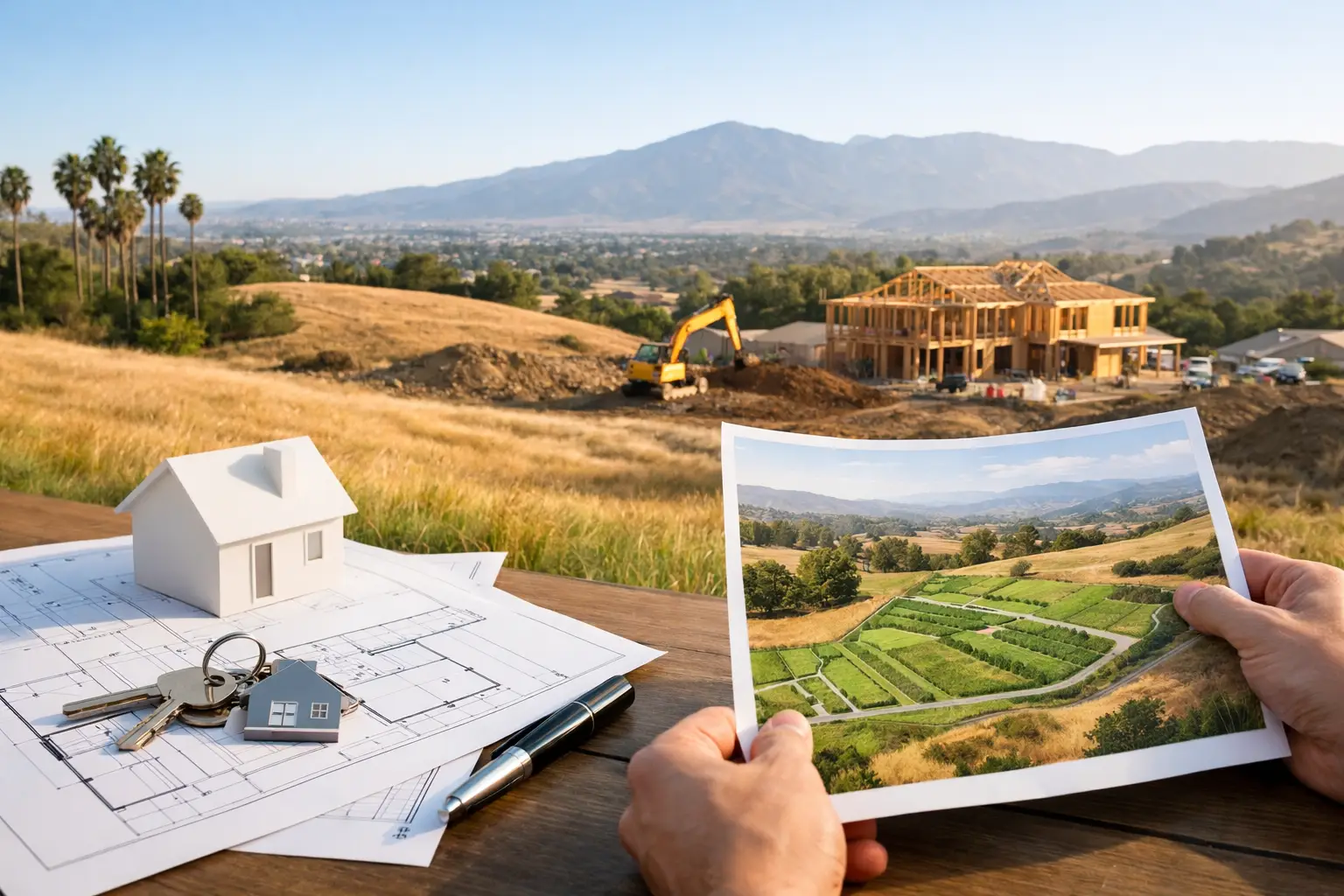
A surprising number of California buyers get the house design right and the land decision wrong. That is usually where the budget starts slipping. If you want to understand how to buy land and build, you need to think like both a property buyer and a construction borrower from day one.
Buying a lot is not the same as buying a finished home. You are not just evaluating square footage, school ratings, and curb appeal. You are evaluating whether the site can actually support the home you want, how much cash or leverage you will need, and whether a lender will view the project as financeable.
How to buy land and build without creating financing problems
The biggest mistake borrowers make is treating land purchase and construction financing as separate decisions when they are closely connected. The lot affects the appraisal, the build budget, the timeline, the permit path, and often the loan structure.
A piece of land may look like a bargain until you factor in grading, retaining walls, utility extensions, septic requirements, coastal or hillside restrictions, or difficult access for equipment. In California, those costs can move quickly. A low land price does not always mean a lower total project cost.
That is why the first step is not shopping for plans. It is defining the full project target. You need a realistic land budget, estimated construction cost, contingency reserve, and a clear idea of whether you want a construction-only loan, a one-time close construction-to-permanent loan, or a structure that includes land payoff. If the financing path is unclear, the project usually gets more expensive.
Start with the total project, not just the lot price
Before making an offer on land, work backward from the finished home you want to build. Think in terms of total development cost, not just acquisition. That includes the purchase price, closing costs, architecture, engineering, site work, utility connections, permits, impact fees, vertical construction, interest reserves, and contingency.
This matters because lenders do not look only at what you paid for the land. They look at the overall transaction, your equity position, your liquidity, your credit profile, your builder strength, and in many cases the as-completed value of the property. A borrower who understands the end value and loan structure early is in a much stronger position than a buyer who only knows the lot is available.
If you already own the land, that may help. Existing land equity can sometimes be used as part of your contribution toward the construction loan. If you are buying the land now and building soon after, there may be financing options that combine those phases more efficiently than closing twice.
Choose land that is buildable, not just desirable
This is where many projects stall. A lot can be beautiful, private, and well located, yet still be difficult to finance and expensive to develop.
You need to verify zoning, setbacks, access, utility availability, topography, drainage, soil conditions, wildfire exposure, and any environmental constraints. In some areas, you also need to understand whether the parcel requires a well, septic system, fire mitigation work, or road improvements. Coastal lots, mountain parcels, and hillside sites often carry extra design and permitting complexity.
A lender will care about many of the same issues for a simple reason. These factors affect completion risk and value. If a parcel has uncertain access, no clear utility path, or major site development costs that are not reflected in your budget, the loan becomes harder to place.
This does not mean challenging lots cannot be financed. It means the file needs to be structured correctly and documented early. The more unusual the property, the more important it is to work with a lender or advisor who understands residential construction lending rather than standard mortgage underwriting.
Due diligence before you close
At minimum, buyers should review title, parcel maps, zoning, utility availability, preliminary site feasibility, and local building requirements before becoming fully committed. If the site is sloped or rural, geotechnical and septic questions may need answers early as well.
The right level of due diligence depends on the property. A flat infill lot in an established neighborhood is different from a raw parcel in a high fire severity zone. The key is simple: do not assume the lot is ready just because it is listed as buildable.
Understand your financing options before you make offers
If you are serious about learning how to buy land and build, financing should move up your priority list. Too many buyers spend months hunting for land and only then discover that the loan structure they assumed was available does not fit their income, down payment, timeline, or property type.
Land loans typically require stronger equity and can carry different terms than standard mortgages. Construction loans add another layer because the lender is evaluating a future asset, not a completed one. Draw schedules, builder approval, plan review, budgets, permits, and appraisals all matter.
For many owner-occupied California borrowers, a one-time close construction-to-permanent loan is attractive because it can reduce repeat closings and simplify the transition from build phase to long-term financing. In other cases, a separate land loan or construction-only loan may make more sense, especially if the timing is uncertain or the project needs more flexibility.
Owner-builder financing is also possible in some cases, but it is more specialized. The borrower usually needs stronger documentation, more liquidity, and a file that makes sense from a risk perspective. Traditional banks often struggle with this. Specialized construction lending channels are usually better equipped to evaluate the real strength of the project.
Get pre-qualified based on the real project
Pre-qualification for a construction project is not the same as getting approved for a resale home. Income still matters. Credit still matters. But lenders also want to understand the plans, budget, timeline, land position, and who will build the home.
If you are still shopping for land, that is fine. You can still get clarity on your likely range. The important thing is to frame the conversation around realistic project size and financing needs, not just a generic payment estimate.
This is where experience matters. A strong construction lender or advisor can help you understand whether your deal will be underwritten based on cost, as-completed appraised value, or some combination of both. That affects leverage, cash to close, and whether the numbers work.
California Construction Loans works with borrowers in exactly this position - buyers who need to structure land acquisition and construction financing correctly before they commit to the wrong property or the wrong loan path.
Build a lender-ready project package
Once you have the land identified or under contract, the strongest borrowers move quickly on project readiness. That usually means assembling plans, specifications, contractor information, a line-item budget, timeline, and any available permit or entitlement status.
Lenders want clarity. If your numbers are rough, the builder is unvetted, or the plans do not match the budget, delays follow. The more complete and coherent your package is, the better your financing options tend to be.
There is always some gray area at this stage. Not every borrower has final permits in hand before applying, and not every project is at the same stage. But there is a big difference between a project that is progressing and a project that is still conceptual.
Appraisal and finished value matter more than many buyers expect
For construction lending, the appraisal is often based on the home as proposed, not just the land as it sits today. That means the plans, specs, and market comparables for the finished product matter a great deal.
This can work in your favor when the completed home supports a higher value than your current site cost suggests. But it also creates pressure to align your design with market reality. Overbuilding for the location or using a budget that is not supported by the market can create a financing gap.
Expect trade-offs and plan for them
Every land-and-build deal has trade-offs. A cheaper lot may require more site work. A premium infill parcel may be easier to permit but cost more upfront. A one-time close loan may simplify the process, while a separate structure may offer flexibility if your timing is uncertain.
There is no universal best answer. The right structure depends on your cash position, intended occupancy, credit profile, construction timeline, and how complete the project is when financing is arranged.
What matters most is avoiding preventable mistakes. Buying land without confirming buildability, underestimating site costs, assuming any bank can handle a construction file, or waiting too long to address the loan structure can all put a good project at risk.
If you are planning to buy land and build in California, treat the financing strategy as part of the build strategy. The borrowers who do this well usually move faster, preserve more options, and avoid the expensive surprises that show up after closing. A well-chosen lot and a properly structured loan can save far more than they cost to set up.
