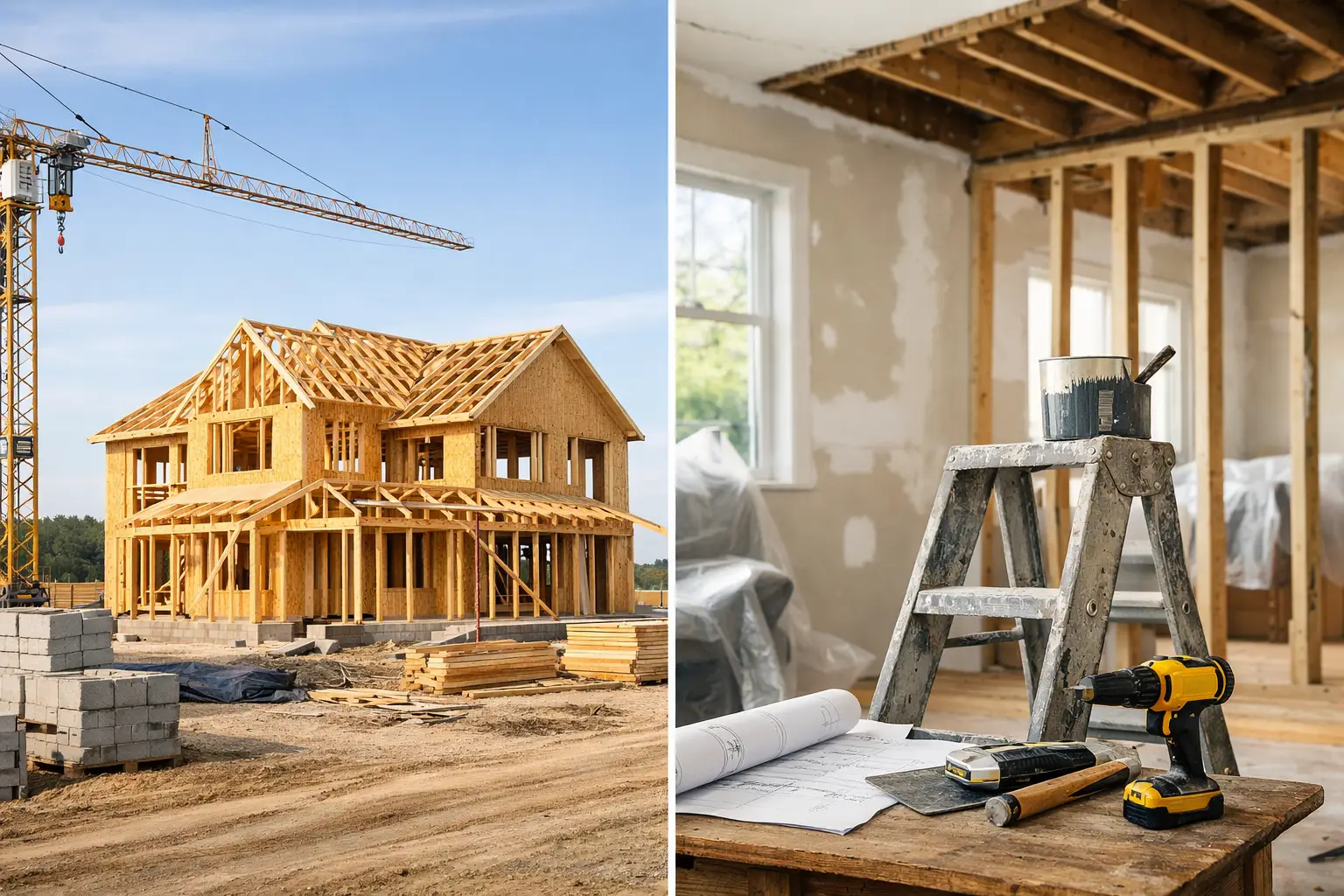
If you're comparing a construction loan vs renovation loan, you're usually past the dreaming stage. You have a real project, real numbers, and one big question: which loan actually fits what you're trying to build or change?
That distinction matters more than most borrowers expect. We talk with California homeowners and property owners every day who assume these loans are interchangeable. They are not. The right structure can increase leverage, simplify closing, and match the project to lender guidelines. The wrong one can slow approvals, limit funds, or force you into a loan product that does not reflect the actual scope of work.
Construction loan vs renovation loan: the core difference
A construction loan is designed for ground-up building or, in some cases, a project that is extensive enough to be treated like new construction by the lender. Think building a custom home on vacant land, tearing down and rebuilding, or financing land plus construction under one structure.
A renovation loan is designed for improving an existing property. That could mean updating a kitchen, adding square footage, reworking floor plans, or completing a major remodel while keeping most of the original structure in place.
The practical difference is this: construction financing is built around creating a home that does not yet exist in finished form, while renovation financing is built around improving a property that already has an established structure and value base.
That sounds simple, but lenders do not draw the line the same way on every file. A major remodel with structural changes, room additions, or near-total reconstruction may fall into renovation with one lender and construction-style financing with another. That is where experience matters.
When a construction loan makes more sense
If you are buying a lot and building from scratch, this is usually straightforward. You need a true construction loan. The same applies if you already own the land and want to finance the build based on the future completed value.
Construction loans are also common when the existing home will be demolished, when the work is too extensive for standard renovation guidelines, or when the project involves owner-builder financing. In California, many borrowers also prefer one-time close construction-to-permanent financing because it reduces duplicate closings and locks the project into a long-term loan structure more efficiently.
This type of financing is especially useful when the value story depends on the finished home, not the current condition of the property. If the site today does not reflect what the end product will be, a construction lender can underwrite to plans, specs, budget, and as-completed value.
That creates more room to structure the loan properly, particularly for custom homes, rebuilds, and higher-cost residential projects.
When a renovation loan is the better fit
A renovation loan works best when the home already exists and the goal is to improve it rather than replace it. If you are modernizing an older house, adding livable square footage, or completing a substantial remodel without crossing into full new construction territory, renovation financing may be the cleaner option.
The benefit is that the loan is tied to an existing residence with a current market presence. Depending on the program, the lender may still consider the after-improved value, which can help support larger project budgets than a simple cash-out refinance or home equity line would allow.
This matters in California, where remodel costs can be high and property values can make a well-planned renovation financially worthwhile. A borrower may want to preserve a strong existing location, expand for a growing family, or upgrade a home instead of trying to buy a different one in a difficult market.
A renovation loan can solve that problem, but only if the scope fits the lender's rules. Cosmetic work is one thing. A major structural remodel is another. The details matter.
How lenders look at each loan type
The approval process for a construction loan is generally more documentation-heavy. Lenders want a full set of plans, detailed specifications, contractor information, line-item budget, timeline, permits or permit readiness, and a draw schedule. They are not just evaluating the borrower. They are evaluating the project itself.
Renovation loans still require project review, but the process can be less complex when the work is clearly tied to an existing home and a defined scope. That said, larger remodels can look very similar to construction underwriting, especially when value, contingency reserves, and staged fund disbursements become central to the file.
In both cases, borrower strength still matters. Credit profile, reserves, income documentation, equity position, and overall debt picture all affect approval. But with these loan types, project readiness often becomes the deciding factor. A strong borrower with incomplete plans can still hit delays. A well-prepared borrower usually moves faster.
Construction loan vs renovation loan on appraised value
This is one of the most important differences and one of the most misunderstood.
With a construction loan, lenders often focus on the future completed value of the home. That means the appraisal is based on what will exist after the project is done, using plans, specs, and comparable finished properties.
With a renovation loan, the lender may look at both the current property and the expected value after improvements. The exact approach depends on the program and scope. For a smaller remodel, the existing value may carry more weight. For a major remodel, the after-improved value may become more important.
Why does that matter? Because leverage changes. If your financing is based only on the property as it sits today, you may not access enough capital to complete the project comfortably. If the lender can underwrite to finished value, the structure may support a larger and more practical loan amount.
That is often the difference between a project that works on paper and one that is actually financeable.
Draws, payments, and closing structure
Construction loans are usually funded in stages through draws as work is completed. You do not receive the entire loan amount upfront. The lender releases funds according to progress, inspections, and approved draw procedures.
Many renovation loans also use draws, especially for larger projects. Smaller renovation programs may be simpler, but once the scope becomes substantial, staged disbursement is common because the lender wants to control how funds are used.
Payment structure also varies. During the build or remodel phase, many construction-style loans allow interest-only payments based on the amount disbursed. That can help cash flow during the project. Long-term terms are then established either through a conversion feature or a separate permanent loan, depending on the program.
If you want fewer moving parts, one-time close options deserve serious consideration. They are not right for every borrower, but they can reduce friction and improve the overall financing experience.
The biggest mistake borrowers make
The biggest mistake is choosing the loan based on a label instead of the actual project.
A borrower says, "I'm remodeling," but the scope includes gutting most of the house, adding a second story, relocating major systems, and rebuilding significant structural components. That may not fit a typical renovation program. Another borrower says, "I'm building," but the property already has a standing home and the work may fit a major remodel loan more efficiently.
Lenders care less about what you call it and more about how the plans, budget, and existing property condition line up with their guidelines.
That is why general mortgage channels often struggle with these files. Residential construction and major remodel financing is specialized. The loan product has to match the real project, not just the borrower's first assumption.
Which loan is right for your California project?
If you are building from the ground up, buying land to build on, replacing an existing home, or financing a project where the future completed property drives the value, a construction loan is usually the right path.
If you are improving a home that already exists and the structure remains fundamentally in place, a renovation loan may be the better fit. If the remodel is unusually large, the answer may depend on which lender sees the project as a renovation and which treats it more like construction.
That is where specialized guidance pays off. California projects come with higher costs, tighter documentation expectations, and more variation in lender appetite. The strongest financing outcome usually comes from structuring the file correctly at the beginning, not fixing it after a bank has already said no.
At California Construction Loans, we help borrowers sort through that complexity and match the project to the right financing structure. If you are weighing a construction loan against a renovation loan, start with the plans, budget, property type, and end value story. The right loan should make the project easier to complete, not harder to explain.


