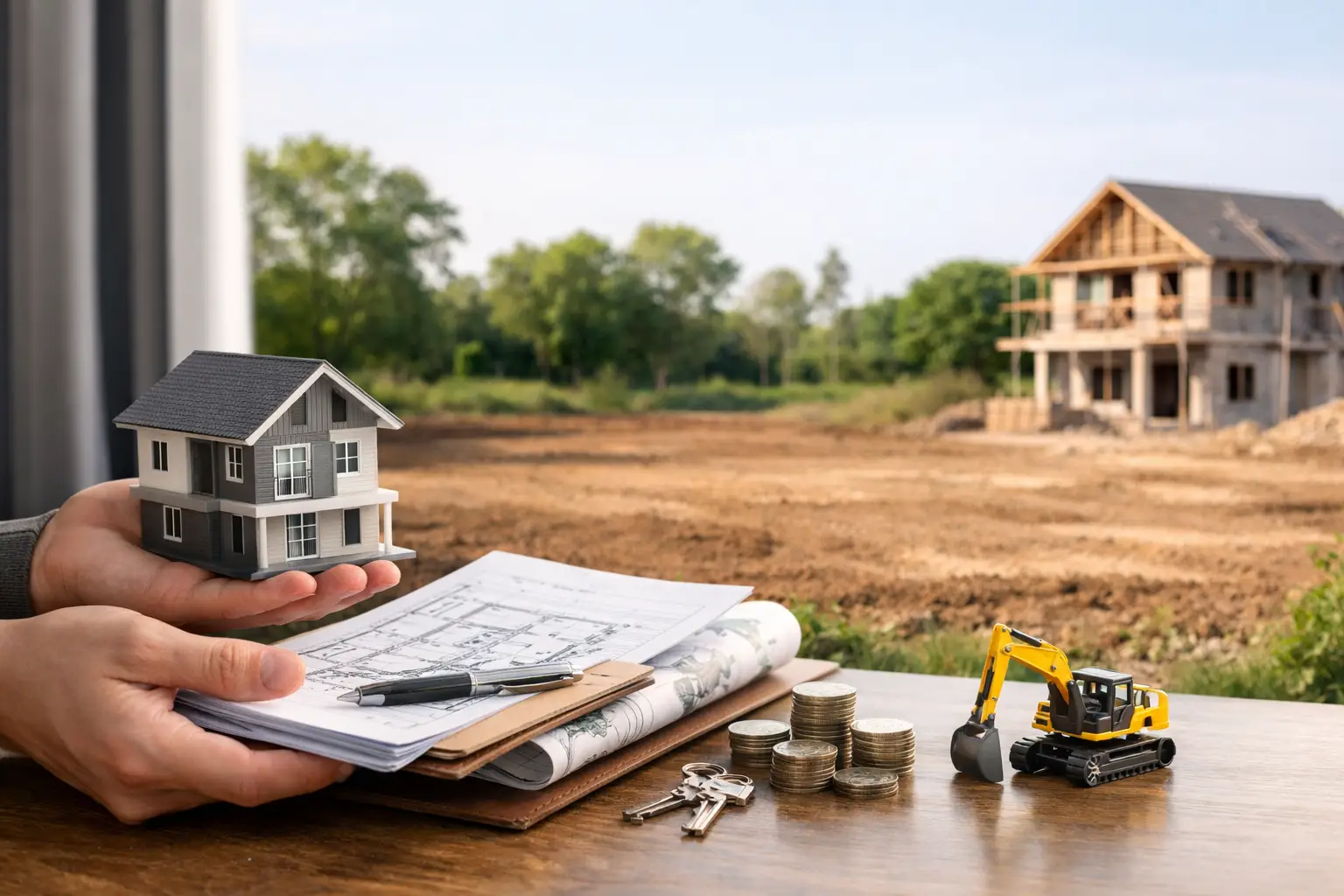
You may already own the most difficult piece of a new-home project: the lot. But owning land does not automatically make financing simple. Building on owned land financing requires a lender to evaluate the land’s current equity, the projected cost to build, your plans and budget, and the home’s appraised value once construction is complete.
For California homeowners, landowners, and future custom-home builders, the right structure can turn existing land equity into a meaningful part of the project’s required investment. The wrong structure can leave you short on funds, forced to bring in additional cash, or dealing with an avoidable refinance after construction. The key is to structure the loan around the entire project, not just the lot.
Why Owning the Land Changes Your Financing
A construction lender generally looks at a project as one combined transaction: the land, the vertical construction costs, and the completed home’s expected value. If you own the land free and clear, or have substantial equity in it, that equity may be credited toward your required down payment or borrower contribution.
For example, a borrower who bought a lot years ago for $250,000 may now own land worth considerably more. That increase in value can be useful equity when financing the build. Rather than needing to provide all of the down payment in cash, the borrower may be able to use qualified land equity to satisfy part of the lender’s requirement.
This does not mean every dollar of land value is available as financing. The lender will order an appraisal, review any existing liens, and apply its loan-to-value or loan-to-cost guidelines. Still, for many borrowers, owned land creates a stronger starting position than purchasing land and financing construction at the same time.
The distinction matters because construction loans are typically underwritten against the completed project. A lender may consider the "as-completed" appraised value of the new home, not simply the cost of the lot plus the contractor’s budget. In high-value California markets, that finished-value approach can create more borrowing capacity than a standard bank structure based only on cost.
Building on Owned Land Financing Structures
The best loan depends on whether the land is free and clear, whether there is an existing loan against it, how much equity you have, and whether you want one closing or separate construction and permanent financing.
One-Time Close Construction-to-Permanent Loans
A one-time close loan combines the construction loan and the permanent mortgage into one transaction. The loan funds construction through a series of draws, then converts to permanent financing when the home is complete.
This can be an efficient solution for borrowers who want to avoid a second closing, a second set of closing costs, and the uncertainty of qualifying for a new mortgage after the build. Your land is typically included in the transaction, and its equity may be applied toward the required contribution, subject to appraisal and program guidelines.
One-time close financing is especially attractive when the borrower wants certainty about the end financing before construction begins. It is not always the best fit, however. Program choices, rate structures, and documentation requirements vary by lender. A specialized review is essential before assuming this option will provide the highest leverage for a particular project.
Construction-Only Loans
A construction-only loan finances the build phase, usually with interest-only payments during construction. When the project is finished, the borrower obtains separate permanent financing to pay off the construction loan.
This approach can work well for borrowers who expect their financial profile to improve before completion, want flexibility in choosing their permanent mortgage later, or are building a project that needs a more customized construction lender. It can also be appropriate for investment properties, spec homes, and certain owner-builder projects.
The trade-off is clear: you will need to qualify for permanent financing later, and there will generally be a second closing. If rates, income, credit, or the final appraisal move in an unfavorable direction, the end loan may not look exactly as expected. This is why the construction and exit strategy should be evaluated together from the beginning.
Using Land Equity as the Down Payment
Land equity is often the central advantage of building on property you already own. If the land is free and clear, the appraised value of the lot may satisfy a significant portion of the borrower’s required investment. If there is an existing land loan, the lender may pay off that balance as part of the new construction transaction, depending on the program.
The exact leverage available depends on the completed-value appraisal, project type, occupancy, credit, reserves, debt-to-income ratio, and lender guidelines. Owner-occupied primary residences often have more favorable options than second homes or investment projects. A larger custom home with extensive site work may also need a more conservative structure, even when the borrower owns valuable land.
What Construction Lenders Will Review
Construction financing is more detailed than a conventional mortgage because the lender is underwriting both the borrower and the project. A strong income and credit profile matter, but so do the plans, builder, budget, and value of the finished home.
Lenders commonly review architectural plans, specifications, a signed construction contract, a line-item budget, the builder’s experience and licensing, and the construction timeline. They also want to understand site conditions. California projects can involve grading, retaining walls, septic systems, wells, utility extensions, coastal restrictions, wildfire requirements, and other costs that are easy to underestimate.
The appraisal is another major factor. The appraiser must identify comparable completed homes that support the value of what you intend to build. Unique designs, remote locations, oversized homes, and luxury finishes can make this more challenging. A high construction budget does not guarantee a matching appraised value.
That is where loan structuring matters. California Construction Loans helps borrowers evaluate lender programs that may use finished-value underwriting and higher loan-to-value options for qualified owner-occupied projects. The goal is to identify the financing path that fits the property, plans, and borrower profile before substantial time is spent on a structure that will not support the project.
Prepare Before You Apply for Financing
The earlier you organize the project, the more accurately a lender can assess your options. You do not need every finish selected before an initial discussion, but preliminary plans and a realistic budget are far more useful than a broad estimate.
Before seeking building on owned land financing, gather these core items:
- A current title report or information on any loan secured by the land
- Preliminary or final plans, specifications, and a detailed construction budget
- Builder information, contract terms, and an estimated construction schedule
- Recent income, asset, and debt documentation
- Information about permits, utilities, grading, and other site-development requirements
It is also wise to set aside a contingency reserve. Even well-planned projects can encounter design revisions, permit delays, material changes, or unforeseen site conditions. A lender may require contingency funds within the budget, but borrowers should also understand what additional liquidity is available if costs exceed the original plan.
Common Issues That Can Affect Approval
Owned land helps, but it does not remove every financing obstacle. One common issue is an existing land loan with a balance that is high relative to current value. Another is a construction budget that exceeds what the completed appraisal can support. In either situation, the borrower may need more cash, a revised scope, or a different loan program.
Owner-builder projects require particular attention. Some lenders will consider an owner-builder loan, while others require a licensed general contractor with a documented track record. If you plan to manage the work yourself, bring that up immediately. It changes the lender pool, documentation requirements, and draw process.
Projects already underway can also be more complex. A lender will need to evaluate work completed, permits, inspections, invoices, and the remaining budget. Financing may still be possible, but it requires an experienced review rather than a standard mortgage application.
Start With the Finished Home, Not Just the Lot
The most productive first step is to evaluate the land, proposed construction budget, and expected finished value together. That analysis shows whether your land equity can support the required contribution, what loan amount may be realistic, and whether a one-time close or construction-only approach makes more sense.
If you own California land and are ready to build, get the financing conversation started before finalizing the construction contract. A clear pre-qualification can give you better control over your budget, your builder discussions, and the home you are planning to create.
